The National Early Warning Score 2 (NEWS2) is a standardised clinical tool used across the NHS to identify acutely ill and deteriorating patients early. Introduced by the Royal College of Physicians (RCP), NEWS2 helps healthcare professionals recognise deterioration, escalate care appropriately, and improve patient outcomes.
This blog explains what NEWS2 is, how it works, how to calculate it, and includes a clear NEWS2 observation form you can use for learning and practice.
What Is NEWS2?
NEWS2 is an updated version of the original NEWS system. It is designed to:
- Detect early clinical deterioration
- Standardise communication between staff
- Support decision-making and escalation
- Reduce avoidable cardiac arrests, ICU admissions, and deaths
NEWS2 is used in:
- NHS hospitals
- Community and mental health services
- Ambulance services
- Care homes with clinical oversight
Why NEWS2 Is Important
✔ Early recognition of deterioration
✔ Consistent assessment across settings
✔ Supports escalation and safety-netting
✔ Central to Immediate Life Support (ILS) and patient safety
Many serious adverse events are preceded by abnormal NEWS2 scores hours earlier.
Physiological Parameters in NEWS2
NEWS2 is based on six physiological observations, plus oxygen use:
- Respiratory rate
- Oxygen saturation (SpO₂)
- Supplemental oxygen
- Temperature
- Systolic blood pressure
- Heart rate
- Level of consciousness (ACVPU)
NEWS2 Oxygen Saturation Scales
NEWS2 includes two oxygen saturation scales:
- Scale 1 – For most patients
- Scale 2 – For patients with hypercapnic respiratory failure (e.g. COPD)
⚠ Scale 2 should only be used when clinically indicated and documented.
How to Calculate a NEWS2 Score
Each parameter is scored from 0 to 3 depending on how abnormal it is.
The scores are added together to give a total NEWS2 score.
Higher scores = greater clinical risk.
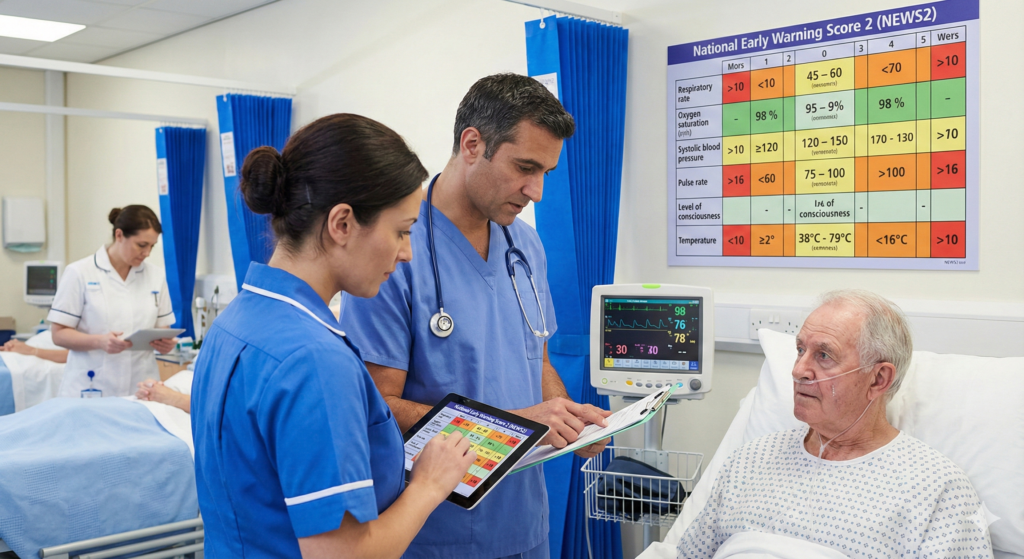
NEWS2 Scoring Table (Simplified)
| Parameter | 3 | 2 | 1 | 0 | 1 | 2 | 3 |
|---|---|---|---|---|---|---|---|
| Respiratory Rate (/min) | ≤8 | 9–11 | 12–20 | 21–24 | ≥25 | ||
| SpO₂ Scale 1 (%) | ≤91 | 92–93 | 94–95 | ≥96 | |||
| On Oxygen | Air | +2 | |||||
| Temperature (°C) | ≤35.0 | 35.1–36.0 | 36.1–38.0 | 38.1–39.0 | ≥39.1 | ||
| Systolic BP (mmHg) | ≤90 | 91–100 | 101–110 | 111–219 | ≥220 | ||
| Heart Rate (/min) | ≤40 | 41–50 | 51–90 | 91–110 | 111–130 | ≥131 | |
| Consciousness (ACVPU) | Alert | V/P/U = 3 |
NEWS2 Observation Form
You can use the following NEWS2-style observation form for practice or documentation:
Credit-Royal College of Physicians
Interpreting NEWS2 Scores
| NEWS2 Score | Risk Level | Recommended Action |
|---|---|---|
| 0–4 | Low | Routine monitoring |
| 5–6 | Medium | Urgent review by clinician |
| ≥7 | High | Emergency response / critical care review |
| Any single 3 | High concern | Escalate even if total score is low |
📌 Trend matters – a rising score is as important as a high score.
NEWS2 and Escalation of Care
NEWS2 supports:
- Early senior review
- Rapid Response / Outreach Team activation
- Clear communication using SBAR
- Safer handovers between teams
Early escalation is a patient safety strength, not a weakness.
NEWS2 in Immediate Life Support (ILS)
In ILS, NEWS2 is used to:
- Recognise the deteriorating patient
- Prevent cardiac arrest
- Strengthen the first link in the Chain of Survival
ILS teaches clinicians to combine:
✔ NEWS2
✔ ABCDE assessment
✔ Clinical judgement
Limitations of NEWS2
⚠ Does not replace clinical judgement
⚠ Less sensitive in some patient groups (e.g. pregnancy, children)
⚠ Must be interpreted alongside the clinical picture
NEWS2 is a tool, not a diagnosis.
Best Practice Tips for Using NEWS2
✔ Record observations accurately and regularly
✔ Escalate early—don’t wait
✔ Document actions taken
✔ Use the correct SpO₂ scale
✔ Listen to patient and staff concern
Final Thoughts
The National Early Warning Score 2 (NEWS2) is a powerful patient safety tool that saves lives through early recognition and timely escalation. When used correctly alongside clinical judgement, NEWS2 helps prevent deterioration, cardiac arrest, and avoidable harm.
Early recognition + early action = safer care.