The Chain of Survival is a fundamental concept in Immediate Life Support (ILS) that describes a sequence of critical actions which, when performed rapidly and effectively, significantly improve survival from cardiac arrest.
In ILS training, the Chain of Survival guides healthcare professionals to recognise emergencies early, act decisively, and work as a team to save lives. Understanding and applying each link is essential in both hospital and community healthcare settings.
What Is the Chain of Survival?
The Chain of Survival refers to a series of time-sensitive interventions that must happen in the correct order following a cardiac arrest. If one link is weak or delayed, the chances of survival drop dramatically.
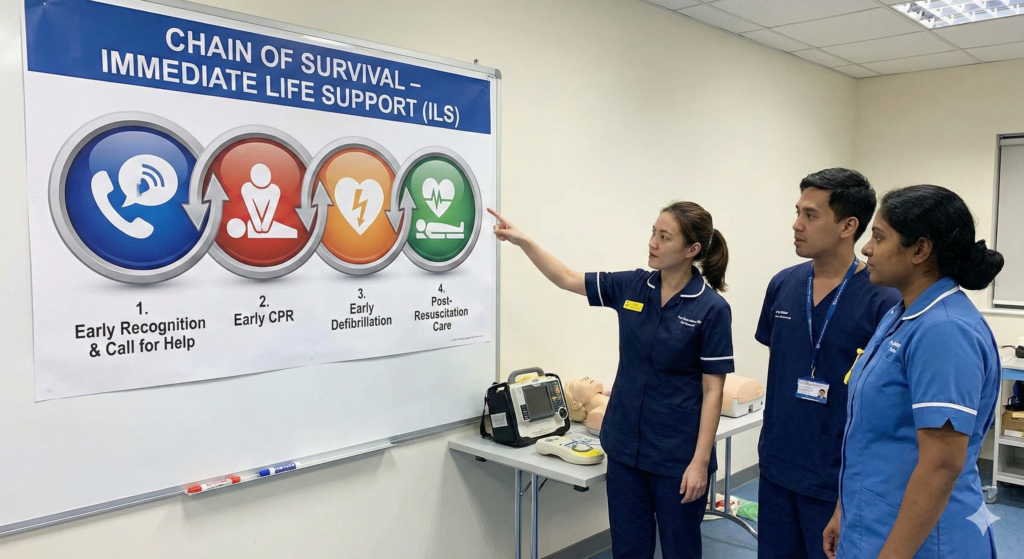
In Immediate Life Support (ILS), the Chain of Survival typically includes four key links:
- Early recognition and call for help
- Early high-quality CPR
- Early defibrillation
- Post-resuscitation care
These steps are based on Resuscitation Council UK (RCUK) guidelines and are central to all ILS courses.
1. Early Recognition and Call for Help
The first and most important link is early recognition of a deteriorating or collapsed patient.
What This Involves
- Recognising signs of deterioration (e.g. abnormal NEWS2 scores)
- Identifying cardiac arrest (unresponsive and not breathing normally)
- Calling for help immediately
- Activating the emergency response / cardiac arrest team
Why It Matters
Early recognition prevents delays and allows rapid mobilisation of skilled help and equipment.
📌 In ILS, this step emphasises ABCDE assessment and escalation of care.
2. Early High-Quality CPR
Once cardiac arrest is identified, immediate high-quality cardiopulmonary resuscitation (CPR) must begin.
Key Elements of High-Quality CPR
- Chest compressions at 100–120 per minute
- Compression depth of 5–6 cm in adults
- Full chest recoil
- Minimal interruptions
- Effective ventilation using bag-valve-mask
Why It Matters
CPR maintains blood flow to vital organs, especially the brain and heart, buying time until defibrillation and advanced care are available.
3. Early Defibrillation
Defibrillation is critical for shockable rhythms such as:
- Ventricular fibrillation (VF)
- Pulseless ventricular tachycardia (VT)
What ILS Teaches
- Rapid attachment of AED or manual defibrillator
- Safe shock delivery
- Minimal interruption to CPR
Why It Matters
Every minute without defibrillation reduces survival by 7–10% in shockable cardiac arrest.
4. Post-Resuscitation Care
Once Return of Spontaneous Circulation (ROSC) is achieved, care does not stop.
Key Components
- Airway and oxygenation management
- Blood pressure and cardiac monitoring
- Identifying and treating reversible causes (4 Hs & 4 Ts)
- Safe handover to advanced or critical care teams
Why It Matters
High-quality post-resuscitation care improves neurological outcomes and long-term survival.
The Chain of Survival in ILS vs ALS
While ALS (Advanced Life Support) includes advanced airway management and drugs, ILS focuses on:
- Early actions
- Teamworking
- Safe and effective basic interventions
ILS ensures that the first few minutes of cardiac arrest management are optimised, which is where survival is most influenced.
Why the Chain of Survival Is Central to ILS Training
ILS courses are designed around:
✔ Rapid decision-making
✔ Clear communication
✔ Role allocation within teams
✔ Repeated practice of each link
By strengthening every link in the chain, healthcare professionals increase the chances of survival for patients experiencing cardiac arrest.
Real-World Application in Healthcare Settings
The Chain of Survival is used across:
- NHS hospitals
- Ambulance services
- Community healthcare settings
- Care homes
- Private hospitals
In many NHS Trusts, understanding the Chain of Survival is a mandatory competency for clinical staff.
Final Thoughts
The Chain of Survival is the backbone of Immediate Life Support. It reminds healthcare professionals that early recognition, prompt CPR, rapid defibrillation, and effective post-resuscitation care work together to save lives.
In ILS, every second counts—and every link matters.