Becoming a doctor in the UK is a respected and rewarding career path—but the journey differs depending on whether you trained in the UK or overseas. This guide explains both routes step by step, covering education, exams, registration, visas, and career progression.
Whether you’re a school student, graduate, or international doctor, this blog will help you understand how to become a doctor in the UK.
Who Regulates Doctors in the UK?
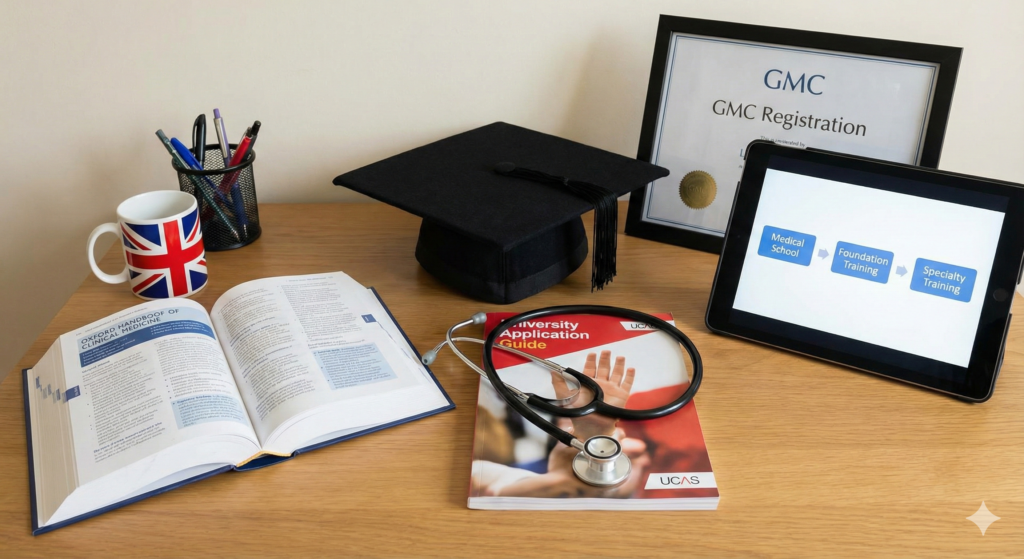
All doctors practising in the UK must be registered with the General Medical Council (GMC). The GMC:
- Sets education and training standards
- Maintains the medical register
- Oversees revalidation and fitness to practise
👉 You cannot work as a doctor in the UK without GMC registration.
🔗 GMC official website: https://www.gmc-uk.org/
Route 1: How to Become a Doctor in the UK (UK-Trained Route)
Step 1: Meet Entry Requirements
To study medicine in the UK, you usually need:
- Strong A-levels (Biology + Chemistry, plus another subject)
- GCSEs including Maths and English
- Entrance exams such as UCAT or BMAT
- Interviews (MMI format)
Step 2: Study Medicine (MBBS / MBChB)
- Duration: 5–6 years
- Award: MBBS, MBChB or equivalent
- Includes clinical placements in NHS hospitals
🔗 GMC-approved UK medical schools:
https://www.gmc-uk.org/education/standards-guidance-and-curricula/education-and-training-standards/approved-medical-schools
Step 3: Foundation Programme (FY1 & FY2)
After graduating, you must complete the UK Foundation Programme:
- FY1: Provisional GMC registration
- FY2: Full GMC registration
This is a 2-year paid training programme in NHS hospitals.
🔗 UK Foundation Programme:
https://foundationprogramme.nhs.uk/
Step 4: Specialty Training
After FY2, doctors choose a career path such as:
- GP training
- Medical specialties (e.g. cardiology)
- Surgical specialties
- Psychiatry
- Emergency medicine
Specialty training can take 3–8+ years.
Route 2: How to Become a Doctor in the UK (International Route / IMG)
International Medical Graduates (IMGs) can work in the UK through several routes.
Step 1: Primary Medical Qualification (PMQ)
You must hold a recognised medical degree from your home country.
🔗 Check acceptable qualifications:
https://www.gmc-uk.org/registration-and-licensing/join-the-register/acceptable-primary-medical-qualifications
Step 2: English Language Requirement
Most IMGs must prove English proficiency:
- IELTS Academic: Overall 7.5 (minimum 7.0 in each section)
- OET: Grade B in all components
🔗 GMC English language requirements:
https://www.gmc-uk.org/registration-and-licensing/join-the-register/english-language-requirements
Step 3: Pass PLAB or Equivalent Route
PLAB Route
- PLAB 1: Written exam (MCQs)
- PLAB 2: Clinical OSCE-style exam (UK-based)
🔗 PLAB exams:
https://www.gmc-uk.org/plab
Alternative Routes (No PLAB)
- MRCP / MRCS / MRCGP
- Sponsorship schemes
- Recognised postgraduate qualifications
Step 4: GMC Registration
Once requirements are met, apply for:
- Full GMC registration (most IMGs)
- Provisional registration (rare for IMGs)
🔗 Apply for GMC registration:
https://www.gmc-uk.org/registration-and-licensing/join-the-register
Step 5: Get a Job in the NHS
Common first roles for IMGs:
- Trust Grade Doctor
- FY2 equivalent
- SHO or Registrar (depending on experience)
🔗 NHS jobs portal:
https://www.jobs.nhs.uk/
Step 6: Visa & Right to Work
Most international doctors work under the:
- Skilled Worker Visa
- NHS employers often provide visa sponsorship
🔗 UK Health & Care Worker visa:
https://www.gov.uk/health-care-worker-visa
Career Progression for Doctors in the UK
Once registered and employed, doctors can:
- Enter specialty training
- Work as SAS (Specialty & Associate Specialist) doctors
- Become consultants
- Move into research, education, leadership, or public health
Costs to Consider (International Route)
Approximate costs:
- IELTS/OET: £300–£500
- PLAB exams: £255 (PLAB 1), £934 (PLAB 2)
- GMC registration: ~£433
- Visa & relocation costs
Key Differences: UK vs International Route
| Aspect | UK Graduate | International Graduate |
|---|---|---|
| Medical degree | UK medical school | Overseas medical school |
| Exam route | Foundation Programme | PLAB / MRCP / sponsorship |
| Registration | Provisional → Full | Usually Full |
| Visa needed | No | Yes |
Final Thoughts
Becoming a doctor in the UK is challenging but achievable for both UK and international candidates. With clear planning, exam preparation, and understanding GMC requirements, thousands of doctors successfully enter the NHS every year.
The UK continues to value and rely on international doctors, offering structured training, career growth, and global recognition.